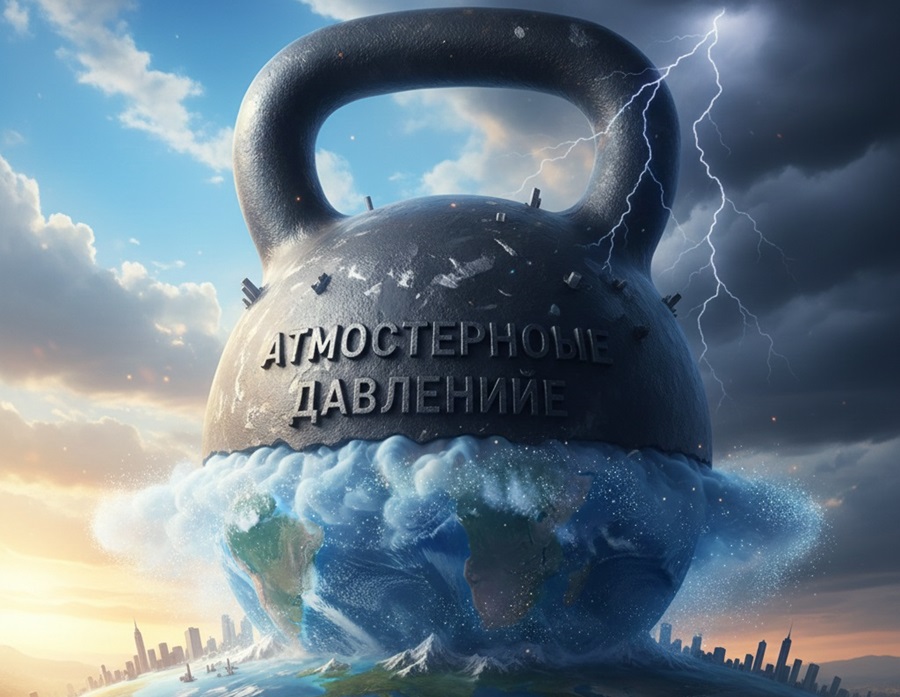
Deadly Pressure
How can we discover what we do not know? Where are the answers from our scientific community—which receives our money from the state budget yet remains silent?
2026-09-20 12:00
We who inhabit planet Earth must know this. We must be prepared for the challenges that await us. I am not certain whether this knowledge can save us, but we must prepare nonetheless. The better we prepare, the greater our chances—as a global human population—of surviving the conditions that have already set in and are continuing to unfold.
Known or unknown
We do not know what is currently happening on our planet. Someone, perhaps, knows something, but we—ordinary people—do not. We do not hear about these events in the news, and we have been conditioned not to look to other sources of information. That is a mistake. Global weather patterns are constantly shifting. Yet, the fact is that by labeling this process "global warming," we overlook a great deal. After all, the main issue right now is not the rise in Earth's temperature—important though that is—nor even the rising sea levels we are constantly warned about.
Something is happening that is reflected in available figures, yet we fail to attach due importance to it: atmospheric pressure is rising. The 760 millimeters of mercury we have grown accustomed to ceased to be the norm long ago. Observe the barometer readings reported in the media—while they are still available there. Better yet, check a barometer in your own home. Temperature is something we can cope with. Sea level is something we can tolerate. But pressure...

Please note that an atmospheric pressure of 760 millimeters of mercury has long since ceased to be the norm. The highest atmospheric pressure ever recorded on Earth was 813 millimeters of mercury. This reading was taken on December 31, 1968, at a weather station located at Lake Agata in the Evenkiysky District of Russia's Krasnoyarsk Krai, at an elevation of 261 meters above sea level. The point is, our standard, run-of-the-mill atmospheric pressure is already within striking distance of that record.
Dinosaur constant
Until quite recently, doctors maintained that the human body is designed to function at an atmospheric pressure of 760 millimeters of mercury. Significant deviations from this norm lead to dizziness, headaches, cardiovascular irregularities, and other adverse health effects—phenomena commonly referred to as "weather sensitivity." All that remains is to explain to people exactly which air conditioner they should hide under to escape high atmospheric pressure.
What we habitually call "global warming" is not merely a warming process. Our planet is currently undergoing a complex, multifaceted transformation. Melting ice leads to an increase in the amount of liquid water. This liquid water evaporates and turns into vapor, and water vapor is a component of the planet's atmosphere. Consequently, the mass of the atmosphere increases, while the mass of the Earth's solid body decreases. You should not assume, my dear fellow intelligent beings, that dinosaurs grew to such enormous sizes simply because there was an abundance of food. No mouse living in a grain storehouse has ever grown to the size of an elephant.

At this point in my narrative, questions arise. The first question is: what constitutes the Earth's mass (m1) in Newton's law of universal gravitation for those of us living between the planet's solid body and its atmosphere? And what constitutes the distance between the bodies? Is this mass and distance calculated with or without the atmosphere? After all, in the context of global warming, water shifts from the planet's solid body into its atmosphere. Is the "gravitational constant G" in Newton's formula sufficiently constant? What happens to our mass in that case? What was the mass or weight of dinosaurs on a warmer Earth?
How the kilogram ceased to be a kilogram
I ask so many questions not because I do not know the answer to any of them. But we live in a world where there are people who know, and then there are people whose articles are published in so-called "peer-reviewed" journals. Is there any way for us to learn the "peer-reviewed" opinion on the questions I have raised? Or is our scientific establishment entirely insulated from questions coming "from below"? I am not asking peer-reviewed science for a certificate of salvation. I simply want to know more about what awaits us. What awaits all of us, including peer-reviewed scientists and the reviewers from those peer-reviewed journals.
So, we have already established that global warming is dangerous not only because of the warming itself and the associated environmental transformations; the volume and weight of Earth's atmosphere are changing as well. We can already see this reflected on barometers across the planet. Crucially, Earth's gravitational pull is changing. In other words, a kilogram on our earthly scales is no longer truly a kilogram—yet we pay full price for every gram of that "deficient" kilogram at the store. If you think I am exaggerating, try answering the questions I posed earlier.
The weight of a single kilogram was originally defined in 1901 based on the mass of a metal cylinder kept at the International Bureau of Weights and Measures in France. However, in 2019, it was decided to define the kilogram using the "Planck constant." I previously explained how one should view such "constant" coefficients—calculated using various formulas—when discussing Newton's "gravitational constant." The official reason for this change was that the mass of the reference kilogram no longer matched the mass of its copies located around the world. In other words, the metal reference kilogram—which had faithfully served humanity for over a century—suddenly "went bad"... Well, you get the idea.
The weight of a kilogram
What is the point of replacing a standard balance scale with the more complex "Kibble balance" if it wasn't the antiquated balance scale that went wrong, but the kilogram itself? Earth's gravitational pull "went wrong" (in quotation-mark terms) because a vast amount of water evaporated from the planet. Furthermore, weighing a kilogram on a Kibble balance begins by taking the physical metal kilogram kept in France and using it to calibrate the balance. This is how scientists determine the value of the "Planck constant" and designate it as a fixed value. In other words, no matter how Earth's gravity—and consequently the weight of that "iron" kilogram on the planet—might change, scientists have voted to treat the value of 6.626 × 10⁻³⁴ as a constant. It is hard to argue with scientists. Any value expressed in numbers is, by definition, a constant. However, this does not apply to the physical properties reflected by that sequence of digits.
But the weight of a kilogram is not just about the amount of sugar or salt in a supermarket. It is also the takeoff weight of an airplane. It is the takeoff weight of a manned rocket, or a rocket carrying a conventional or nuclear warhead. It is also a factor in the targeting of old combat missiles that remain in secret silos, awaiting the "launch" command. People may not realize this, but these old missiles are targeted at specific geographic coordinates, and their flight paths are calculated based on the missile's weight, the weight of its fuel, and Earth's gravity—a force that was once considered constant. Science does not know where an old missile would fly if Earth's gravity were to change.
Old combat missiles remain on active duty. They are too valuable to simply be discarded as scrap; their disposal is extremely costly, and no one wants to foot the bill. Yet, as long as these old missiles remain in their silos, they pose a threat: should they be launched, they might not strike their originally intended targets.
And it is not just a matter of the standard kilogram weight having "deteriorated," or even of atmospheric pressure rising. Other aspects of the issue raise questions. Just how high can atmospheric pressure on Earth rise, and how much can our planet's gravitational pull decrease? Does this pose a danger to humans? And when will all this happen? We need to know our planet a little better. We must realize that the entire population of Earth cannot fit onto the International Space Station. Some might fly off into space, but the rest will remain on Earth—on the planet we need to know more about.
Каждый ваш вклад имеет большое значение. Поддержите независимые научные исследования автора и помогите более глубоко изучать важные темы сегодняшнего дня
Пополнить банку на независимые научные исследования
Author: Sergii Prosvietov
Просмотров всего: 11383 Просмотров сегодня: 11383

Law of Ukraine "On Protection of Personal Data" of 01.06.2010 № 2297-VI
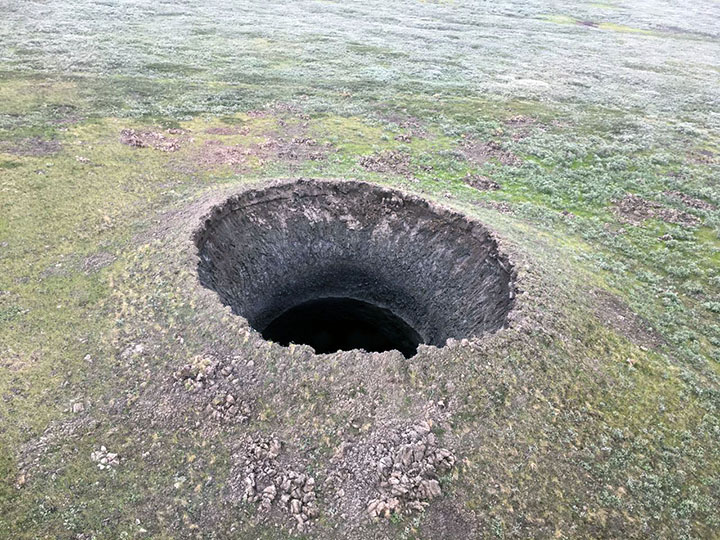
The tundra is exploding from warming